

Compliance Areas (Standards by Application & Regulatory Scope)
Standards are not organized by publisher in real-world operations. They are organized by risk, regulatory requirements, and operational responsibility.
This page helps you navigate industry standards by compliance objective, allowing you to quickly identify what applies to your organization, project, or certification goal.
Each section connects you to relevant standards, implementation guides, and official purchasing options through American National Standards Institute (ANSI)-authorized sources.
Table of Contents
Workplace Safety & OSHA Compliance

Standards aligned with federal workplace safety regulations and enforcement requirements from the Occupational Safety and Health Administration (OSHA), helping organizations reduce risk, protect workers, and maintain compliance in industrial and construction environments.
While OSHA defines legal requirements through regulations such as 29 CFR 1910 and 1926, many organizations implement structured safety management systems to improve consistency and audit readiness. For a detailed breakdown of how these frameworks compare, see OSHA vs ISO Requirements for Metal Fabrication.
Organizations looking to formalize their safety programs often align with ISO-based systems. To understand how certification works, start with What Is ISO Certification?, then explore implementation options with Buy ISO 45001.
Includes:
- OSHA 29 CFR 1910 (General Industry)
- OSHA 29 CFR 1926 (Construction)
- ANSI Z87.1 (Eye & Face Protection)
- ANSI Z359 (Fall Protection Systems)
- ANSI A92 (Aerial Lift Equipment)
- ANSI B11 (Machine Safety)
Selecting the right standard depends on your operational risk profile and industry. High-risk environments can reference ISO 45001 for High-Risk Manufacturing, while organizations planning implementation should evaluate cost and scope using How Much Does ISO 45001 Cost?.
Supports compliance in:
- Personal Protective Equipment (PPE) programs
- Fall protection and working at height
- Machine guarding and operator safety
- Construction site safety
- Lockout/Tagout (LOTO) procedures
Many organizations integrate safety with quality systems to streamline audits and documentation. For a comparison of how safety and quality standards align, review ISO 9001 vs ISO 45001 or explore system integration in Integrated Management Systems.
Related Guides:
- OSHA vs ISO Requirements for Metal Fabrication
- ISO 45001 for High-Risk Manufacturing
- How Much Does ISO 45001 Cost?
- ISO 9001 vs ISO 45001
➡ Explore Workplace Safety Standards & OSHA Requirements
Quality Management & Certification (QMS)

Standards used to implement and certify structured Quality Management Systems (QMS), helping organizations improve consistency, customer satisfaction, and operational performance.
Most organizations begin with a foundational understanding of ISO requirements before pursuing certification. If you’re new to the process, start with our ISO 9001 Certification Guide. For a broader overview of how certification works across industries, see What Is ISO Certification?
- ISO 9001 (QMS Requirements)
- ISO 9000 (Fundamentals & Vocabulary)
- ISO 9004 (Performance Improvement)
- ISO 13485 (Medical Devices QMS)
- ISO 17025 (Testing & Calibration Laboratories)
Before purchasing, it’s important to understand which documents are required and how they differ. You can compare core standards in ISO 9000 vs 9001 vs 9004 or explore whether purchase is necessary in Do You Need to Buy ISO 9001 to Get Certified?
This section supports:
- Certification preparation
- Document control programs
- Internal audit systems
- Corrective and preventive action processes
Organizations often evaluate cost, timeline, and implementation complexity before moving forward. For planning purposes, review How Much Does ISO 9001 Cost?, estimate your investment with the ISO Certification Cost Calculator, and understand the process in ISO Implementation Timeline for Manufacturers.
For manufacturing-specific requirements, see ISO Standards Required for Manufacturing, or explore how quality integrates with other systems in Integrated Management Systems.
Related Guides:
- ISO 9001 Certification Guide
- What Is ISO Certification?
- How Much Does ISO 9001 Cost?
- ISO Implementation Timeline for Manufacturers
➡ View ISO Quality Management Standards & Certification Guides
Environmental & Sustainability Compliance

Standards supporting environmental performance, regulatory compliance, and sustainability initiatives across manufacturing and industrial operations.
Organizations are increasingly expected to manage environmental impact, energy usage, and regulatory reporting. Many begin by implementing a structured Environmental Management System. If you’re evaluating where to start, see Environmental Standards for Manufacturing or begin with What Is ISO Certification? for a broader understanding of how these systems are applied.
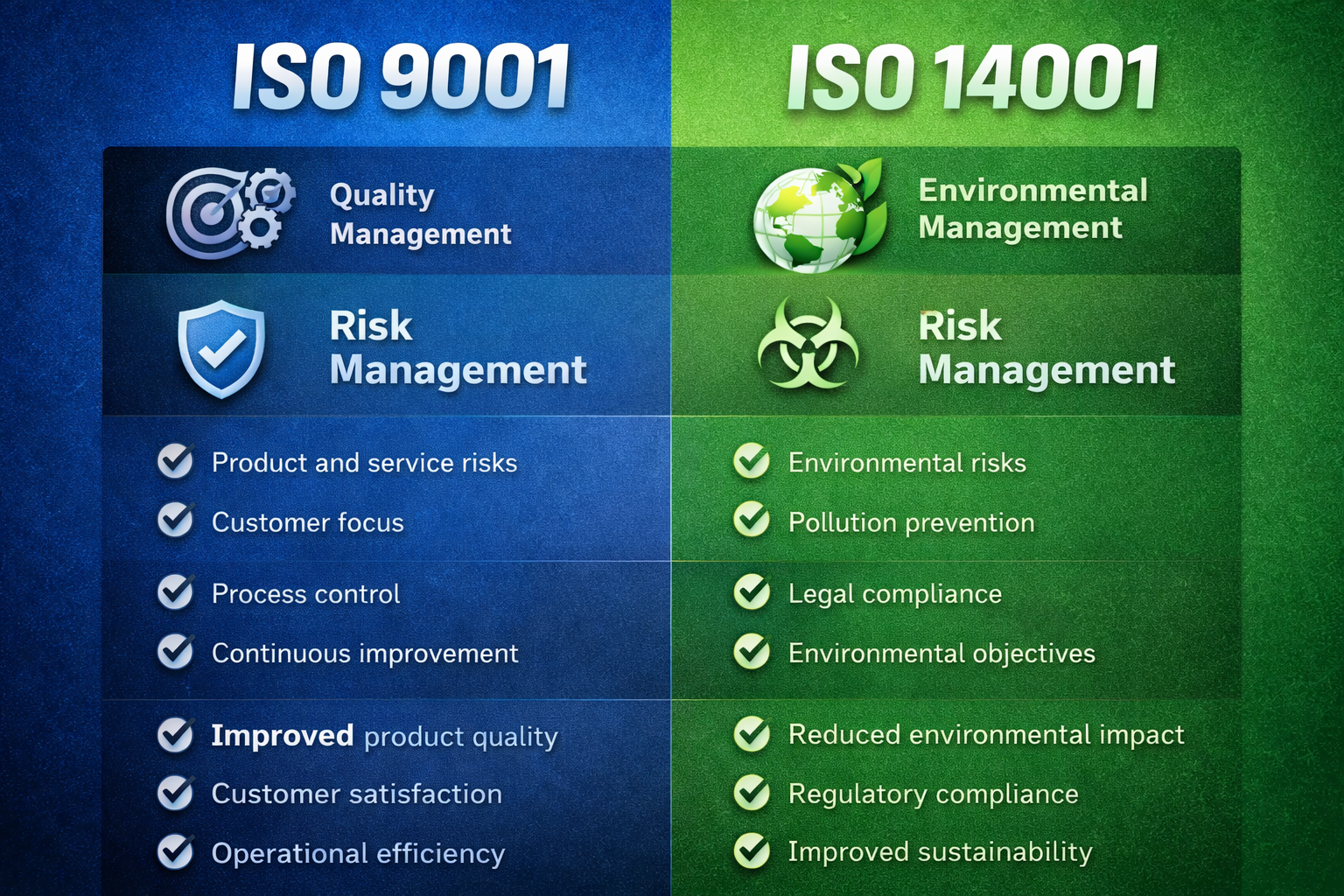
The most widely adopted framework is ISO 14001, which provides a structured approach to identifying environmental risks, reducing impact, and maintaining compliance. To understand implementation in real-world operations, review ISO 14001 for Production Facilities or explore procurement options with Buy ISO 14001.
Includes:
- ISO 14001 (Environmental Management Systems)
- ISO 14004 (Implementation Guidance)
- ISO 50001 (Energy Management Systems)
- Environmental management and sustainability frameworks
Organizations often evaluate cost, integration, and certification scope before implementation. For planning purposes, review How Much Does ISO 14001 Cost? and compare system overlap in ISO 9001 vs ISO 14001 and ISO 14001 vs ISO 45001.
Designed for:
- Environmental management systems (EMS)
- Energy efficiency and sustainability programs
- ESG and corporate responsibility initiatives
- Regulatory reporting and compliance tracking
Many companies integrate environmental systems with quality and safety programs to streamline audits and reduce duplication. To understand how multiple standards can work together, explore Integrated Management Systems.
Related Guides:
- Environmental Standards for Manufacturing
- ISO 14001 for Production Facilities
- How Much Does ISO 14001 Cost?
- ISO 9001 vs ISO 14001
➡ Browse Environmental Compliance & ISO 14001 Resources
Information Security & Data Protection
Standards governing cybersecurity, data protection, and information risk management across digital and operational environments.
As organizations become more digitally connected, managing information security risk is no longer optional. Many companies begin by understanding how certification frameworks apply across different standards. For a foundational overview, see What Is ISO Certification? and Are ISO Standards Mandatory?.
Information security standards are typically implemented as formal management systems, similar to quality and environmental frameworks. Organizations already operating under ISO standards often integrate security into broader compliance structures. To see how multiple systems can work together, explore Integrated Management Systems.
- ISO 27001 (Information Security Management Systems)
- ISO 27002 (Security Controls)
- ISO/IEC 42001 (AI Management Systems)
- Information risk management and data governance frameworks
Adoption of these standards depends on regulatory requirements, customer expectations, and operational risk. Organizations in manufacturing and industrial sectors may also evaluate how security aligns with existing compliance programs. For a broader view of required standards across industries, review ISO Standards Required for Manufacturing.
Used for:
- Cybersecurity compliance and risk mitigation
- Data protection and privacy programs
- AI governance and emerging technology oversight
- Enterprise risk management frameworks
As digital systems become more integrated with operations, organizations often align information security with quality and compliance systems to improve audit readiness and reduce risk exposure.
Related Guides:
- What Is ISO Certification?
- Are ISO Standards Mandatory?
- Integrated Management Systems
- ISO Standards Required for Manufacturing
➡ View Information Security Standards
Construction & Industrial Operations

Standards used in construction, fabrication, and heavy industrial environments where safety, structural integrity, and code compliance are critical to operations.
These environments often require alignment between multiple standards bodies, including American Society of Mechanical Engineers (ASME), American Welding Society (AWS), and ASTM International for material specifications and testing methods. If you’re evaluating how these overlap in real-world applications, start with Welding Standards: AWS vs ASME vs ISO.
Many fabrication and field service organizations also implement ISO-based quality systems to standardize operations and improve inspection consistency. For a breakdown tailored to fabrication environments, see Quality Standards for Fabrication Shops and ISO 9001 Requirements for Fabricators.
- ANSI A10 (Construction Safety Standards)
- American Society of Mechanical Engineers (ASME) codes
- ASTM International material specifications and test methods
- American Welding Society (AWS) welding codes
- Equipment, fabrication, and field compliance standards
Understanding which standards apply depends heavily on your operation type. Machine shops and production environments can reference ISO Standards Required for Machine Shops, while broader operations can use the Manufacturing Compliance Checklist to identify gaps across safety, quality, and production.
Relevant for:
- General contractors
- Fabricators
- Industrial service providers
- Engineering and EPC firms
Because construction and industrial work often intersects with workplace safety regulations, many organizations also evaluate OSHA alignment alongside ISO systems. For a direct comparison, review OSHA vs ISO Requirements for Metal Fabrication.
Related Guides:
- Welding Standards: AWS vs ASME vs ISO
- Quality Standards for Fabrication Shops
- ISO 9001 Requirements for Fabricators
- Manufacturing Compliance Checklist
Medical Devices & Healthcare Compliance

Standards used in regulated medical manufacturing environments where product safety, risk management, and traceability are critical to compliance.
Medical device organizations operate under strict regulatory oversight, including requirements from the U.S. Food and Drug Administration (FDA). Many manufacturers implement ISO-based management systems to align with regulatory expectations and ensure consistent quality. If you’re new to certification frameworks, start with What Is ISO Certification? or review Who Can Issue ISO Certification? to understand how accredited certification works.
The primary standard for medical device quality systems is ISO 13485, which builds on quality management principles with additional requirements for documentation, traceability, and regulatory alignment. Organizations often integrate ISO 13485 with broader quality systems depending on their operations. For comparison and foundational understanding, see ISO 9000 vs 9001 vs 9004 or review ISO Standards Required for Manufacturing.
Includes:
- ISO 13485 (Medical Devices Quality Management)
- ISO 14971 IMedical Devices Risk Management)
- Alignment with U.S.FDA-aligned quality system and regulatory requirements
- Documentation, traceability, and validation standards
Before implementation, organizations typically evaluate certification scope, documentation requirements, and overall cost. For planning purposes, explore How Much Does ISO Certification Cost? and review the process in ISO Implementation Timeline for Manufacturers.
Designed for:
- Medical device manufacturers
- Quality and regulatory compliance managers
- Contract manufacturers and suppliers
- Healthcare and life sciences operations
Because of the high level of regulatory scrutiny, organizations must maintain strict control over documentation, risk management, and supplier quality. For broader insight into supplier expectations and quality controls, see Supplier Quality Requirements (SQRM Guide).
Many companies also integrate medical device standards with other management systems to improve efficiency and audit readiness. To understand how systems can be combined, explore Integrated Management Systems.
Related Guides:
- What Is ISO Certification?
- Who Can Issue ISO Certification?
- ISO Implementation Timeline for Manufacturers
- Supplier Quality Requirements (SQRM Guide)
➡ View Medical Device Standards
Energy, Oil & Gas Compliance

Standards used in energy production, refining, pipeline infrastructure, and industrial processing where safety, pressure integrity, and regulatory compliance are critical.
Operations in this sector rely on a combination of design codes, inspection standards, and material specifications. Key frameworks include those from the American Petroleum Institute (API), American Society of Mechanical Engineers (ASME), and ASTM International for material performance and testing.
Many organizations also implement ISO-based management systems to standardize processes, improve traceability, and reduce operational risk. For a broader understanding of how these standards apply across industries, start with ISO Standards Required for Manufacturing or review What Is ISO Certification?
Includes:
- API standards (equipment, inspection, and operational practices)s
- ASME codes (pressure vessels, piping, and boilers)
- ASTM material specifications and testing standards
- Pipeline safety and integrity management frameworks
- Risk-based inspection and maintenance standards
Selecting the right combination of standards depends on your role in the value chain. Fabricators, maintenance providers, and plant operators often rely on structured compliance frameworks to ensure consistency. Use the Manufacturing Compliance Checklist to evaluate your current program, or review Supplier Quality Requirements (SQRM Guide) for upstream and vendor-related expectations.
Because failures in energy and industrial environments can carry significant financial and safety consequences, many organizations evaluate the broader impact of compliance gaps. For insight into operational risk, see Cost of Non-Compliance in Manufacturing.
Used for:
- Refining and processing operations
- Pipeline construction and integrity management
- Pressure vessel and piping fabrication
- Industrial maintenance and turnaround services
- Energy infrastructure and facility operations
Organizations often integrate quality, safety, and environmental systems into a unified framework to improve audit readiness and reduce duplication. To understand how these systems work together, explore Integrated Management Systems.
Related Guides:
- Manufacturing Compliance Checklist
- Supplier Quality Requirements (SQRM Guide)
- Cost of Non-Compliance in Manufacturing
- ISO Standards Required for Manufacturing
➡ View Energy & Oil Standards
How to Use This Page
Navigating industry standards can be complex, especially when multiple regulations, certifications, and operational requirements overlap.
Use this page as a starting point to identify the standards that apply to your organization:
- Identify your regulatory or certification objective (quality, safety, environmental, etc.)
- Select the applicable compliance area above
- Review the relevant standards and supporting guides
- Determine which standards are required vs. recommended
- Purchase the correct current edition from authorized sources
If you are new to standards or certification, start with What Is ISO Certification? to understand how these frameworks are applied. You can also explore Are ISO Standards Mandatory? to clarify when compliance is required versus optional.
Before purchasing any document, it’s important to understand what you actually need. Use Where to Buy ISO Standard to ensure you’re getting the correct version from authorized distributors, and compare formats in Digital vs Printed ISO Standards.
🧭 Not Sure Where to Start?
If you are:
- Preparing for certification
- Responding to an OSHA citation
- Launching a new management system
- Entering a regulated industry
- Updating an outdated standard
Start with your foundation:
- ISO 9001 Certification Guide (quality systems and core framework)
- ISO Standards Required for Manufacturing (industry-specific requirements)
- Manufacturing Compliance Checklist (practical starting point)
These resources provide structured, real-world guidance to help you move from uncertainty to implementation.
Affiliate Disclosure
This page includes affiliate links to authorized standards publishers. If you purchase through these links, we may earn a commission at no additional cost to you. All standards are obtained through official sources.
🧠 Don’t Buy the Wrong Standard
Before you purchase your next ISO, ANSI, or industry standard, get the breakdown first.
Standards are expensive, and in many cases, organizations purchase documents they don’t actually need or misunderstand how they apply.
Subscribe for practical insights:
- What changed in the latest edition
- Whether you need companion documents
- Certification vs. guidance clarification
- Industry-specific applicability insights
Avoid unnecessary purchases. Get clarity before you buy.
👉 Subscribe for compliance insights